THE MULTI-GENERATIONAL IRA DILEMMA: WHY INCOME-SECURE RETIREES SHOULD CONSIDER INSTITUTIONAL CAPITAL REPOSITIONING

For retirees whose daily lifestyle expenses are comfortably covered by Social Security, pensions, or real estate cash flow, a multimillion-dollar Traditional IRA or 401(k) presents a unique structural challenge. When you don't need your pre-tax retirement accounts for living income, holding millions in traditional accounts can shift from acting as a wealth builder to becoming a growing tax liability.
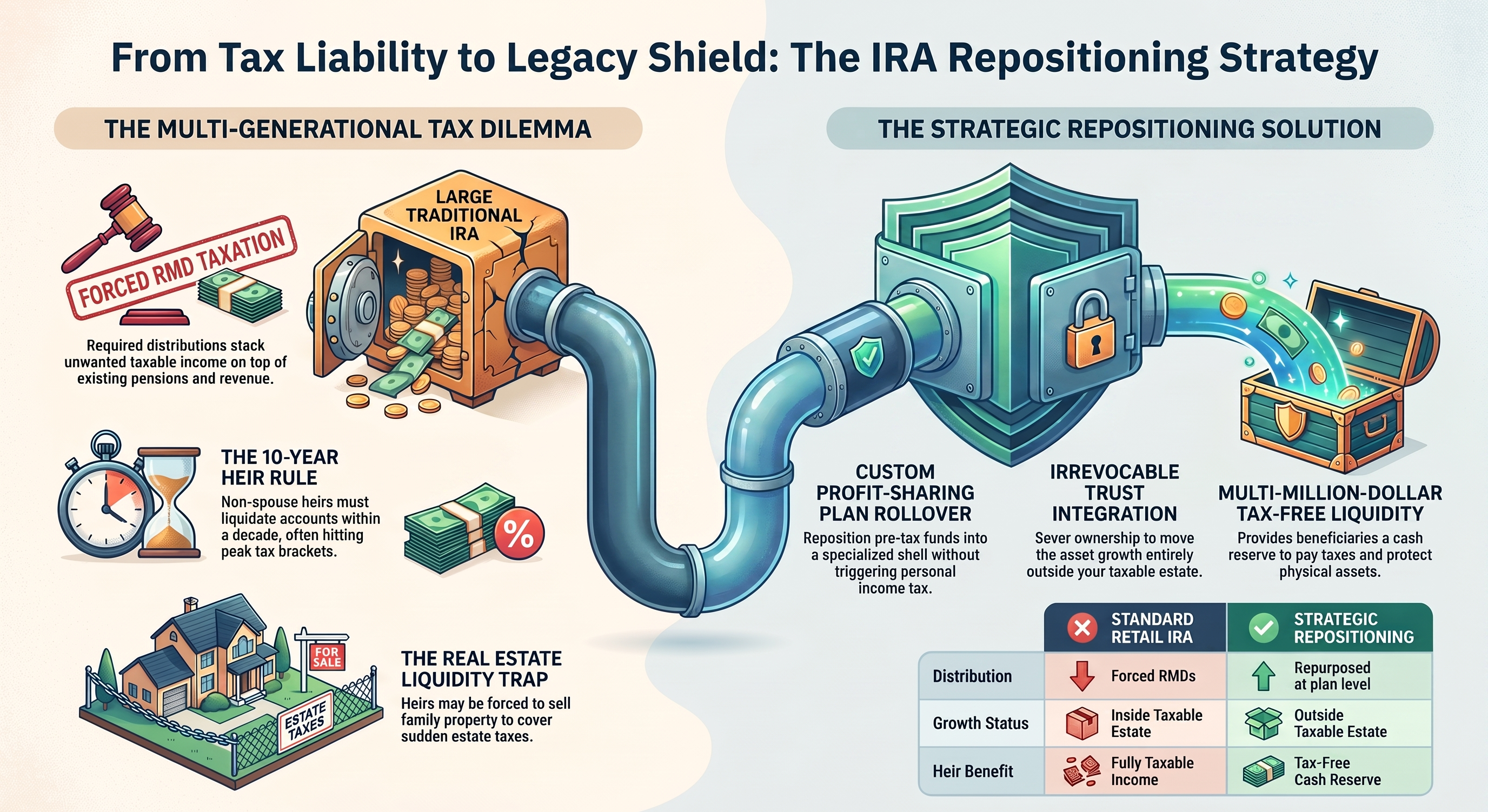
The Problem: Income Tax Compression & Illiquid Asset Risks
High-net-worth estates can face three distinct tax pressures under standard retirement rules:
1. Forced RMD Taxation
Required Minimum Distributions (RMDs) force taxable income out of your accounts annually, stacking unwanted income on top of existing pension and real estate revenues.
2. The 10-Year Inherited IRA Rule
Under current beneficiary distribution rules, non-spouse heirs must liquidate inherited pre-tax accounts within 10 years, frequently forcing large distributions into their peak earning years and pushing them into top marginal tax brackets.
3. The Real Estate & Illiquid Asset Trap
Passing down valuable physical property—such as commercial real estate, multi-family units, or family land—can leave heirs cash-poor. When federal or state estate tax liabilities occur, heirs without accessible liquidity are often forced to sell real estate quickly to cover tax bills.
Why This Requires a Different Approach
Most retail advisors treat 401(k)s and Profit-Sharing Plans (PSPs) as interchangeable accounts because both reside under Section 401 of the Internal Revenue Code.
However, they contain different internal mechanisms. Traditional IRAs and off-the-shelf 401(k)s are designed strictly for personal income drawdowns. In contrast, custom-designed Profit-Sharing Plan frameworks can contain specialized provisions that, when properly structured and administered, may allow pre-tax capital to be deployed toward institutional wealth preservation instruments. This is a highly technical area governed by strict IRS and ERISA compliance requirements.
An Alternative Approach: Strategic Asset Repositioning
Rather than taking personal, taxable distributions to purchase estate protection out-of-pocket with post-tax dollars, some advanced wealth design strategies explore using pre-tax IRA capital itself as part of a broader legacy plan.
[ Pre-Tax IRA / 401(k) Capital ]
│
▼ (Direct Rollover)
[ Custom Profit-Sharing Plan (PSP) ]
│
▼ (Pre-Tax Funding & Compliant Valuation)
[ Irrevocable Estate Protection Trust ]
│
▼
[ Potential Tax-Advantaged Liquidity for Heirs ]
In this type of framework, pre-tax funds are repositioned into a specialized qualified plan shell. The asset may then be transitioned into an irrevocable trust using strict, compliant valuation standards. When properly structured and administered by qualified professionals, this approach is generally intended to address three objectives:
| Repositioning Pillar | Intended Strategic Benefit | Estate Planning Impact |
|---|---|---|
| Addresses Forced RMD Erosion | Designed to reduce annual tax compounding on forced distributions | Pre-tax capital is repositioned at the plan level, subject to applicable tax rules. |
| Aims to Reduce Estate Tax Exposure | Designed to minimize future estate tax exposure on asset growth | Intended to help position capital growth outside of probate, when properly structured. |
| Provides Liquidity Options for Heirs | Designed to help reduce the likelihood of a forced sale of real estate assets | Intended to provide liquidity to help satisfy estate liabilities without requiring the sale of land or property, subject to proper structuring. |
Is Your Pre-Tax Account a Candidate?
Because this strategy relies on specialized plan document design, precise actuarial valuation protocols, and trustee coordination, it is not an off-the-shelf financial product, and it is not appropriate for every situation.
For account holders with $1M to $10M+ in pre-tax assets who are already income-secure, this type of repositioning may be worth exploring as part of a multi-generational legacy plan—but it requires individualized analysis and coordination with qualified tax and legal professionals.
Evaluate Your Account Eligibility
Let's examine your pre-tax IRA/401(k) portfolio to determine whether institutional capital repositioning may be worth exploring for your estate.
This article is for educational purposes only and does not constitute investment, insurance, legal, or tax advice. Strategies described above are highly individualized, subject to strict IRS and ERISA compliance requirements, and are not guaranteed to produce any specific outcome. Please consult a licensed tax advisor and attorney before pursuing any qualified plan repositioning strategy.