WHY "WHEN" IS ONLY HALF THE STORY: RSSA® ANALYSIS VS. SSA PROCESSING

Most people assume that if they have a question about Social Security, the right person to ask is Social Security. That assumption is understandable—and it's also the source of most of the mistakes retirees make. SSA employees are trained to process claims accurately and keep the system running. They are, by policy, not permitted to give personalized advice about when or how to claim in a way that maximizes a specific household's lifetime benefit.
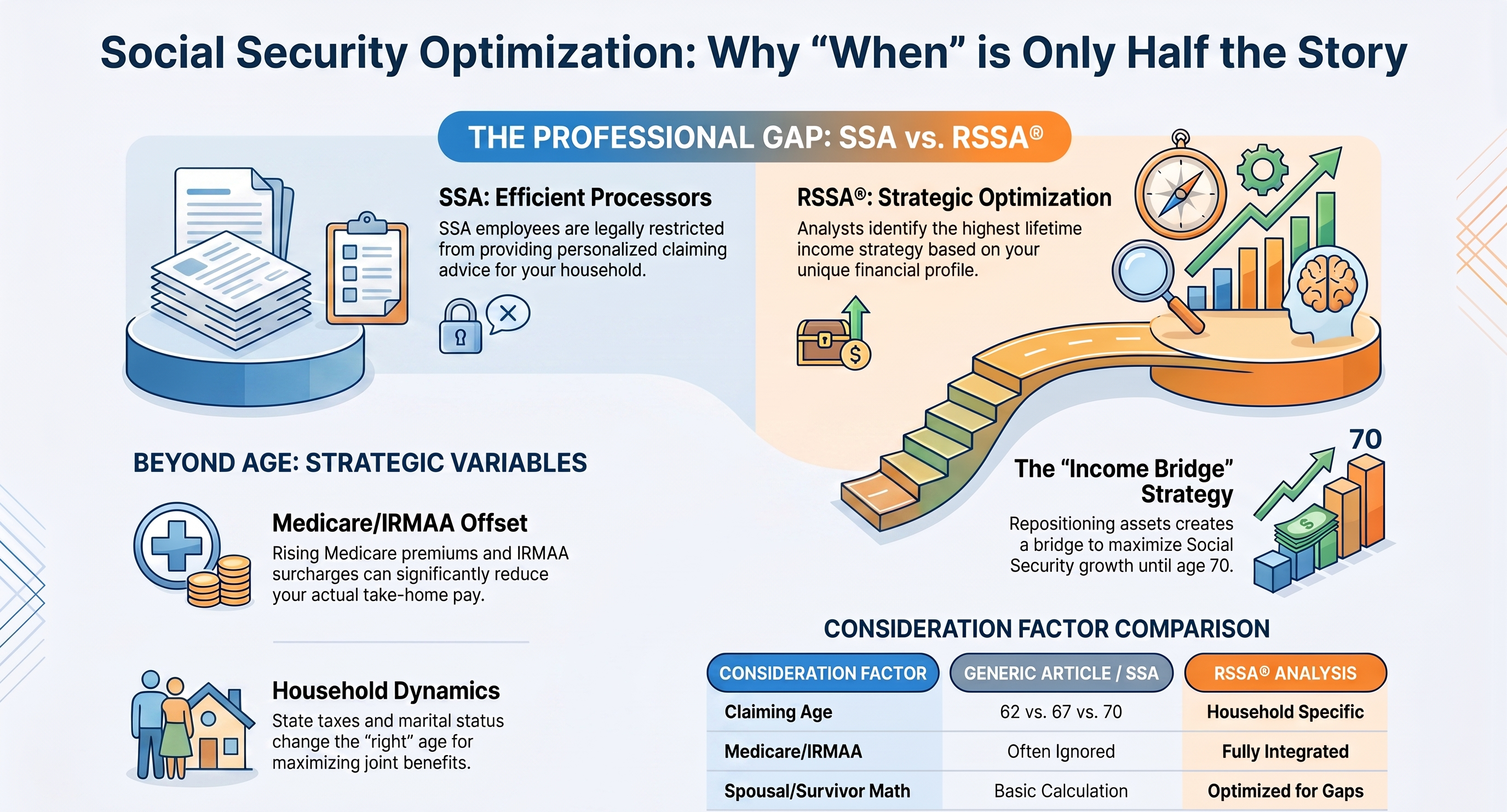
The Professional Gap: SSA vs. RSSA®
An SSA employee can tell you the rules. A Registered Social Security Analyst® is trained to run the math on your actual household—your age, your spouse's age, your health, your other income sources, your state of residence—and identify which claiming strategy produces the most lifetime income for your specific situation, not a generic one.
COLA Isn't Keeping Up the Way People Assume
Every year, Social Security benefits get a Cost-of-Living Adjustment (COLA) meant to keep pace with inflation. What doesn't get nearly as much attention is what happens on the other side of the ledger: Medicare Part B premiums, and IRMAA surcharges for higher earners, have in many years risen faster than the COLA itself.
Since Medicare Part B premiums are typically deducted directly from your Social Security check, a rising COLA can be partially—or in some years, almost entirely—offset by a rising Medicare premium. For higher-income retirees subject to IRMAA, the math can be even less forgiving, since IRMAA is based on income from two years prior.
Why 62 vs. 67 vs. 70 Is an Incomplete Question
Ask any generic retirement article "when should I claim Social Security?" and you'll get some version of "wait until 70 if you can." That's not wrong, exactly—but it's incomplete, because it ignores nearly every variable that actually determines the right answer for a specific household.
Where You Live Matters
Several states still tax Social Security benefits at the state level, and state treatment of pensions, IRA withdrawals, and annuity income varies enough to change the math.
Marital Status & Age Difference Matter
Spousal and survivor benefits are calculated differently than individual benefits, and a significant age gap between spouses changes the survivor benefit math substantially.
Dependents Matter
Minor children or a Disabled Adult Child (DAC) can unlock dependent benefits that most claiming calculators don't account for.
Your Balance Sheet Matters
A household with $150,000 saved has a fundamentally different risk tolerance for delaying Social Security than a household with $1.5 million. The claiming decision isn't made in isolation from the rest of the portfolio.
A Real-World Example: The Income Bridge Strategy
(Figures below are illustrative only—actual results depend on age, health, interest rates, product terms, and market performance, and are not guaranteed.)
Imagine a 65-year-old with $800,000 saved, planning to retire but not yet ready to claim Social Security. Instead of claiming early just to generate income, one option is to reposition a portion of those savings—say, $400,000—into an income-focused annuity, generating income to bridge the gap alongside a younger spouse's earnings.
During that bridge period, Social Security continues growing toward its maximum value, and the remaining invested balance is no longer being drawn down for living expenses—removing the pressure to sell into a down market. At 70, Social Security is claimed at its highest value, with the survivor benefit locked in at the higher amount as well.
The Takeaway:
This isn't really a question about when to claim. It's a question about how every piece of the household balance sheet works together to make the delay possible in the first place.
Find Your Household's Number
Let's run the analysis to find out what the rules actually mean for your household.
This article is for educational purposes only and does not constitute investment, insurance, or tax advice. The hypothetical example above is illustrative only; actual outcomes depend on individual circumstances, product terms, and market performance, and are not guaranteed. Please consult a licensed professional before making any financial decisions.